
Set up the Chart of Accounts in QuickBooks & learn Import/Export
May 9, 2026
Admin |
Estimated Read Time : 5 MIN
Setting up a chart of accounts in QuickBooks is an expensive task. In this guide, you will learn how to set up a chart of accounts along with the import and export of data. Business owners, accountants, and freelancers have been looking for a complete guide on the chart of accounts in QuickBooks, and with this fact in mind, we carefully crafted this blog to provide you with concrete information and solutions.
We usually update our pages regularly with the updates from Intuit. You can bookmark this guide for further use!
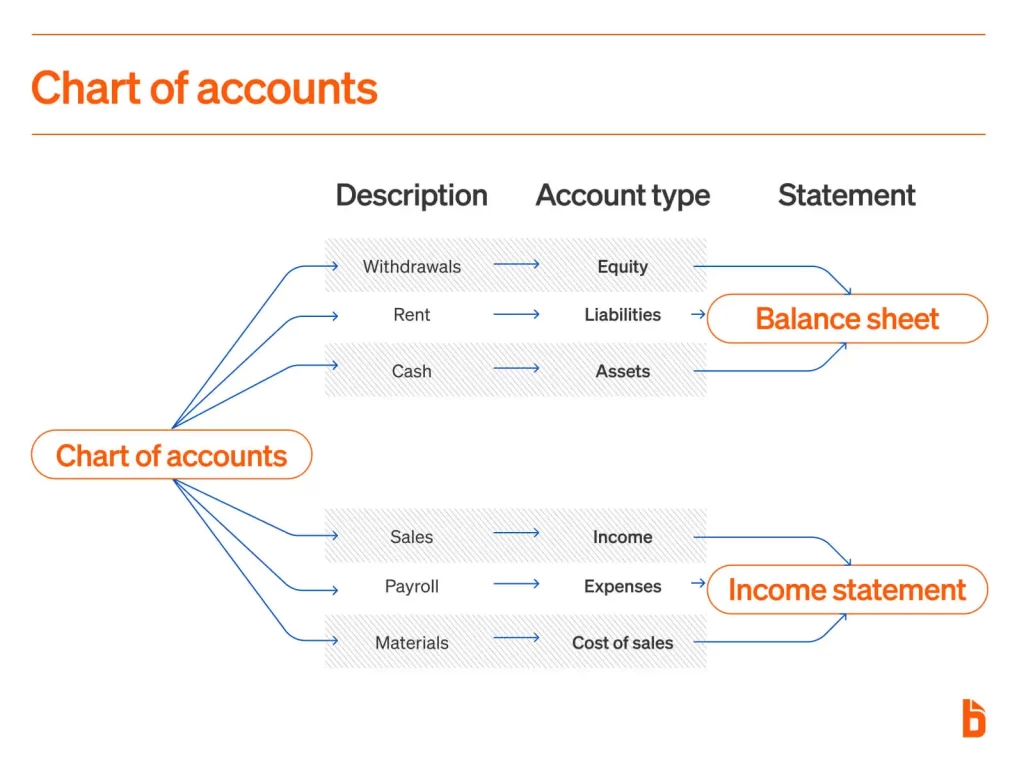
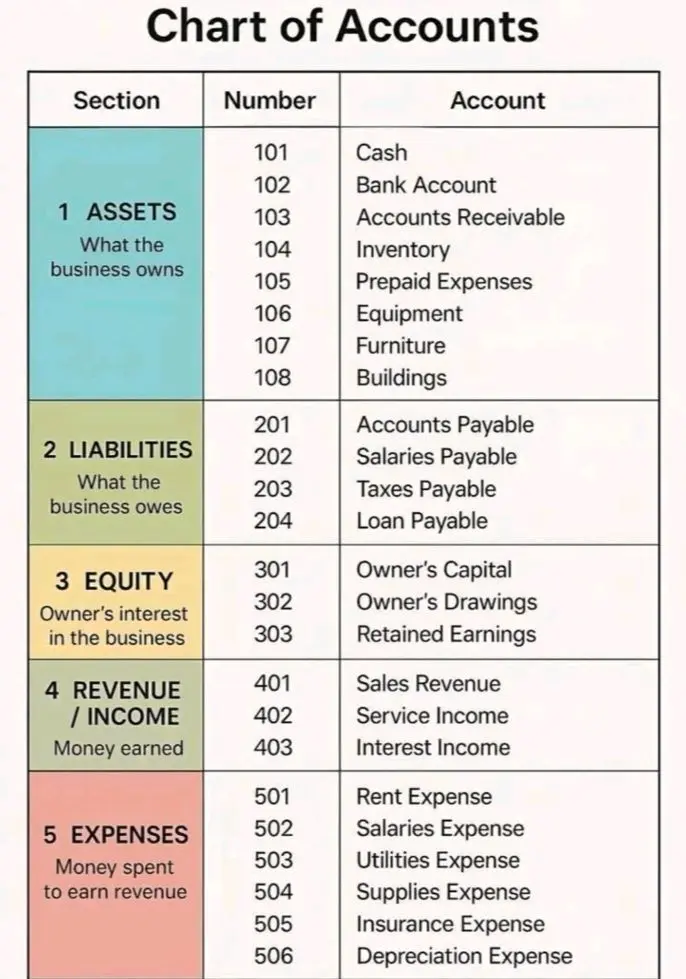
A chart of accounts is a list of the financial account numbers and names mentioned in the company’s general ledger. In the chart of accounts, there are four categories: assets, liabilities, income, and expenses.
If you really want to understand the balance sheet and income statement, you would first understand the components that comprise the chart of accounts.
How to export the chart of accounts in QuickBooks?
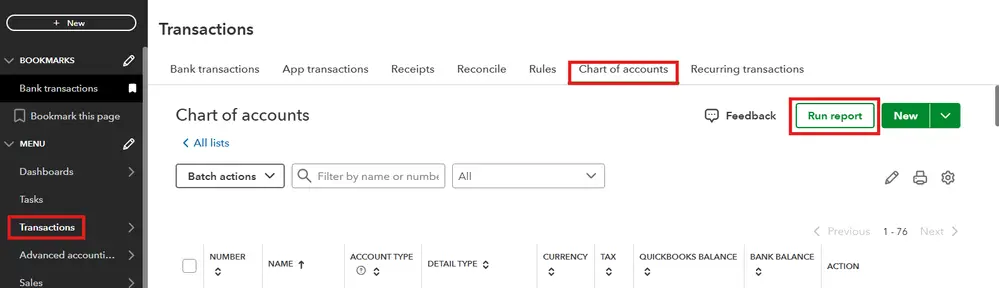
Navigate to the Transactions.
Choose Chart of Accounts and click Run report.
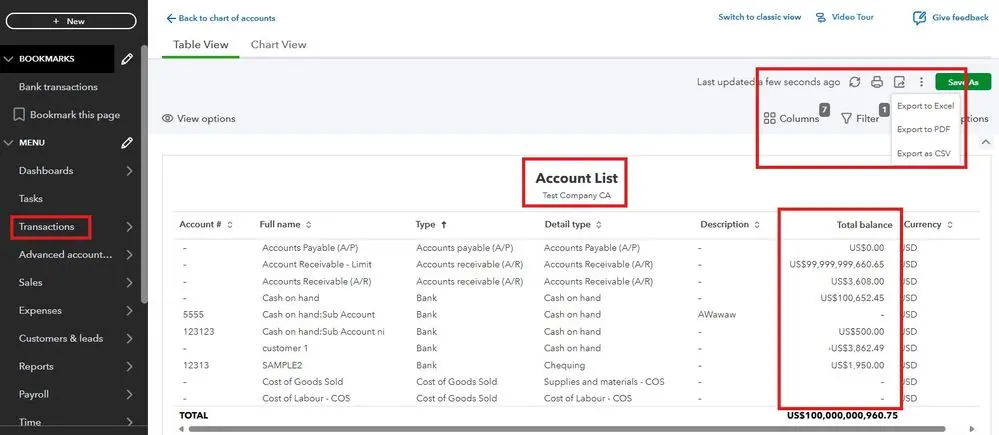
Customize the required details and then click on Export icon.
Now, click on Export to Excel.
The Chart of Accounts organizes a company’s assets, liabilities, income, and expenses. If you are looking to add an account, edit an existing account, or edit an account’s history, follow this guide till the end!
Import your chart of accounts to QuickBooks Online
Step 1: Format your spreadsheet
Using an Excel CSV file, you can import your chart of accounts. In this guide, we will share with you the simple steps so you can import the chart of accounts to your QuickBooks.
Open your existing spreadsheet of accounts.
Or, you can create a new one.
Ensure to have these columns in your spreadsheet:
Account Name
Type
Detail Type
Number
In case you use numbers to set your accounts, it is necessary to add an Account Number column. You can simply skip if you do not use account numbers.
You can add a Currency column if you have different currency accounts.
Having a subaccount? You can add it in the account name column with the format: Mainaccount: subaccount.
Is everything good to go? You can save your spreadsheet in Excel or CSV format.
Account Number
Account Name
Type
Detail Type
112720
Checking Account-Bank of America
Bank
Checking
Money Market – First National Bank
Bank
Money Market
410790
Product Sales Revenue
Income
Sales of Product Income
500780
Cost of Materials
Cost of Goods Sold
Supplies & Materials
Step 2: Upload your spreadsheet
Log in to your QuickBooks Online account.
Click on Settings and select Import Data.
Click on Chart of Accounts.
Wants to upload a file?:
In your PC, browse the file and choose it. Then, open the file.
In Google Sheets, click on Connect to log in to your Google account.
Now, select the required file and then click on Select.
Finally, hit Next.
Step 3: Map your spreadsheet fields to QuickBooks fields.
Map your account once you upload your spreadsheets. This results in the correct import of the data.
Click on the Your File drop-down and match the names to the QuickBooks Online field for:
Detail Type
Account Name
Account Number
Type
Currency
You can select No Match with the exception of Account Name if there is a field that do not match the column in your spreadsheet.
Step 4: Review and import your accounts
Give a final watch before you import your accounts.
Ensure to add accounts and detail types.
If there is a red-highlighted field, take your cursor there and check what needs to be fixed.
Now, you can uncheck any account that must not be saved or deleted.
Click on Import if you find everything good.
Step 5: Enter opening balances for accounts
Navigate to the Settings and click on the Chart of Accounts.
Fetch your credit card and bankaccount.
Click on the Action drop-down and click on Edit.
You can choose the time to start tracking your finances.
Enter the amount in your account column and determine the as-of date in the Balance field.
Finally, click on Save.
Delete the chart of accounts in QuickBooks Online
If you are looking to delete the chart of accounts, follow the steps shared:
Click on the gear icon.
Select Chart of Accounts under the Your Company section.
Select the account that you want to delete.
In the Action column, choose the drop-down and click on the Delete button.
Finally, click on Yes and delete the required file.
Set up a chart of accounts using the QuickBooks Online template
Your chart of accounts is a set of lists that comprise your company’s accounts and balances.
Step 1: Download the QuickBooks Online template
Download the QuickBooks Online template
Navigate to Bookkeeping and click onthe Chart of Accounts.
Select Import using the drop-down arrow.
Click on Download a sample file.
Explore the template
Now, you are required to choose the template as per your requirements. This would help you in improving accuracy and save your time setting up your chart of accounts.
Customize the account
Let us customize the chart of accounts! What you need to do is:
Add new accounts and rename the template.
Kee your file type as .xlsx or .csv.
Setting the account hierarchy
Your header will be the Name of your new account.
In the row, you are required to copy the header name and add a colon at the end.
In the same row, after the colon, add the sub-account name.
You can use the same account type for both accounts.
Fixing and resolving import errors
Error
How to fix
Account number
Use a unique number for this account.
Account name
Use a unique name for this account.
Account type
Choose an option from the preset list to ensure this account is set up correctly.
Detail type
Choose an option from the preset list to ensure this account is set up correctly.
Tax rate
Choose an option from the preset list to ensure this account is set up correctly.
Currency
Choose an option from the preset list to ensure this account is set up correctly.
Opening balance
Use a number value for this field, or leave blank if no balance is needed.
Date
We don’t recognise that date format. Double-check the details and try again.
Sample accounts for your new chart of accounts
Account name
Account Type
Detail Type
Billable Expense Income
Income
Service/Fee income
Contractor Expenses (non-salary)
Expenses
External services
FBT Liabilities
Current liabilities
BAS payable
Freight & Delivery – COS
Cost of Sales
Shipping, Freight and Delivery – COS
Fuel & oils
Expenses
Auto
Gas and electricity
Expenses
Utilities
Gifts and donations
Expenses
Charitable contributions
GST Liabilities Payable
Current liabilities
BAS payable
Insurance
Expenses
Insurance
Interest expense
Expenses
Interest paid
Conclusion
This guide brought you exclusive information and solutions on the chart of accounts in QuickBooks. Since we have covered the setup and import/export of the chart of accounts in QuickBooks, you can click on the link to get the details of how to delete the chart of accounts in QuickBooks.
Frequently Asked Questions
1. What is a Chart of Accounts in QuickBooks?
A chart of Accounts is a list of accounts that every business needs to categorize their transactions as assets, liabilities, income, expenses, and equity. The Chart of Accounts is considered the backbone of the business. With the Chart of Accounts, you can outdo your financial goals.
2. How do I set up a Chart of Accounts in QuickBooks Online?
Follow the steps to share the Chart of Accounts in QuickBooks Online:
Go to Settings and click on Chart of Accounts.
Now, choose New and then select the accounttype, detail type, and name.
You can base your setup on a sample chart of accounts for QuickBooks or an industry-specific preset such as construction, property management, or rental properties.
3. Does QuickBooks offer a Chart of Accounts template?
Yes. QuickBooks provides built-in Chart of Accounts templates. You can also download or create a QuickBooks Chart of Accounts template in Excel for bulk editing or importing. Industry-specific samples like non-profit, construction, or property management are available as well.
4. How do I import a Chart of Accounts into QuickBooks Online?
If you are looking to import a Chart of Accounts in QuickBooks Online:
With an Account Name, Type, detail type, and number, prepare an Excel or CSV file.
Now, click on Settings and select Import Data.
Select the Chart of Accounts and upload your file.
5. How do I export the Chart of Accounts from QuickBooks or QuickBooks Online?
If you are looking to export the Chart of Accounts in QuickBooks Online, apply the shared steps below:
Click on the Settings.
Select Chart of Accounts.
Click on Run Report and then ExporttoExcel.
For QuickBooks Desktop:
Open Chart of Accounts.
Click on Reports and select Account Listing.
Now, export it to Excel or create a PDF.
If you create a PDF, it would help you when you need a QuickBooks Chart of Accounts list PDF. In another case, when you want to migrate your data.
6. How do I print the Chart of Accounts in QuickBooks Desktop or Online?
For QuickBooks Desktop:
Click on the Reports and select List.
Now, select Account listing and finally hit on Print.
For QuickBooks Online:
Open the chart of Accounts.
Click on Run Report and hit Print.
It would help you in getting a hard copy for reviews or audits.
7. How do I delete a Chart of Accounts in QuickBooks Online?
You cannot delete accounts entirely, but you can make an account inactive. To delete/inactivate a Chart of Accounts in QuickBooks Online, click the gear icon next to the account, then select Make Inactive. This keeps historical data intact but removes the account from active use.
8. How do I edit the Chart of Accounts in QuickBooks Online?
It is easy to edit the Chart of Accounts in QuickBooks Online:
Go to Settings and click on Chart of Accounts.
Select Edit and then adjust the name, account number or detail type.
This would help you in customizing your Chart of Accounts numbering or renaming categories.
About The Author
Lana Creston is an experienced technical and accounting writer with a total of 9 years of experience. She currently works on QuickBooks accounting and technical guides at QuickBookSupportNet. Lana has a passion for reading and writing about various technical topics, especially exploring new accounting methods and software, while continuously expanding her expertise in the ever-evolving field of finance and technology.
Effortlessly handle data tasks or get expert assistance with:
Data Automation
Conversion & Migration
Integration
Tax Filing & Compliance
QuickBooks Desktop 2023 is ending — Upgrade QuickBooks Desktop 2023 to 2024 for continued performance and support.