
Learn How to Merge Vendors in QuickBooks Desktop

Mar 19, 2026

Admin |

Estimated Read Time : 5 MIN

Keeping your vendor list organized is essential for accurate bookkeeping and smooth financial management. Over time, duplicate vendor entries can appear due to data imports, spelling differences, or multiple users creating records. These duplicates may cause reporting errors and confusion when tracking expenses or payments. Learning how to Merge Vendors in QuickBooks Desktop helps eliminate redundant profiles while preserving transaction history. 

When you Merge Vendors in QuickBooks Desktop correctly, you maintain clean records and improve the accuracy of your financial reports. This guide will explain why it’s important and outline the basic steps to successfully Merge Vendors in QuickBooks Desktop without losing critical data.

Why Merge Duplicate Vendors in QuickBooks? 

Merging duplicate vendors in QuickBooks helps keep your records accurate and organized. When the same supplier is entered more than once, transactions can become split between profiles, which may lead to reporting errors and confusion. By merging duplicates, you combine all past transactions into a single vendor record, ensuring accurate balances, cleaner reports, and easier tracking of payments and expenses. It also simplifies vendor management and reduces the risk of mistakes when entering future transactions.

Learn How You Can Merge Vendors in QuickBooks Desktop 

When duplicate vendor profiles appear in your company file, it’s important to combine them properly to avoid reporting errors and payment confusion. Merge duplicate vendor accounts with the detailed steps below: 

Important: Be careful when choosing the profile to merge. In case you need to restore an already merged vendor, you will need to recreate the profile manually. 

What you’ll need

Do the following before you make any changes: 

  • Edit or grant access to the vendor/supplier profiles in QuickBooks Online.
  • Choose the Company name and Display name of your vendor/supplier profile you wish to keep. 

Merge your duplicate supplier profiles

  • Follow this link to complete the steps in the product.
  • Look for the vendor profile that you don’t want to keep and select it. 
  • Select the Edit dropdown and then choose Merge contacts
  • Choose the supplier that you wish to merge from the Into dropdown. 
  • Click on Merge contacts.

Results

This combines two vendor profiles into a single record. QuickBooks transfers all previous transactions from the duplicate profile to the one you choose to retain. The extra vendor profile is then set to Deleted (it will appear as inactive).

Merge duplicate accounts

Keep in mind: merging accounts is irreversible, so only merge vendor profiles that were created in error.

  • To open your Chart of Accounts, use the provided link and follow the steps for your product (it will open in a new window).
  • Locate the account you want to keep. In the Action column, click the dropdown ▼ and choose Edit.
  • Take note of the Account name, Account type, and Detail type. These details must match exactly for the accounts to be merged.
  • Determine whether the account is a parent or subaccount. Subaccounts appear indented in the Name column of the Chart of Accounts. If it’s a subaccount, record the parent account it belongs to.
  • Return to the Chart of Accounts (select Take me there).
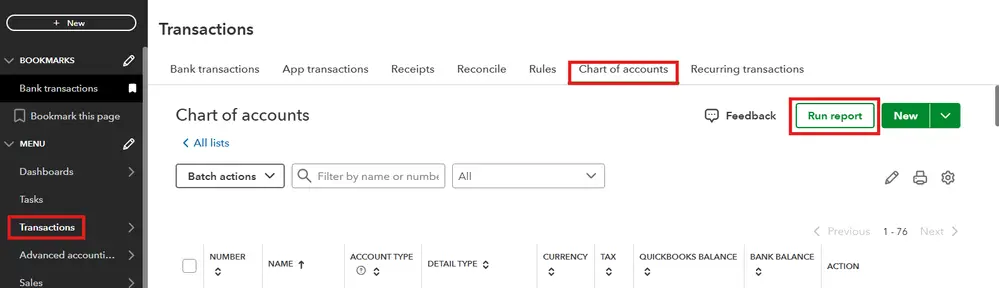
Choose Chart of Accounts and click Run report
  • Find the duplicate account (the one you plan to remove). In the Action column, click the dropdown ▼ and select Edit.
  • Update the Account name and Detail type so they match the account you’re keeping.
  • If adjusting subaccounts, keep the following in mind:
    • When merging two parent accounts, confirm that neither has subaccounts attached.
    • When merging two subaccounts, ensure both are assigned to the same parent account.
    • If only one account is a subaccount, change its Account type to match the parent account exactly and uncheck Make this a subaccount so it becomes a parent account.
  • Once everything matches, click Save, then choose Yes, merge accounts. QuickBooks will transfer all previous transactions from the duplicate account to the one you’re keeping.
  • Click Save to complete the process.

Conclusion 

Merging vendors in QuickBooks is a practical way to eliminate duplicate entries, maintain accurate records, and keep your accounts payable organized. While the process is straightforward, it’s important to follow the correct steps and review your vendor details carefully to avoid unintended data changes. By consolidating duplicate vendor profiles, you ensure cleaner reports, smoother transactions, and more reliable financial tracking.

If you’re unsure about merging vendors or encounter any issues during the process, seek guidance from a certified QuickBooks ProAdvisor. Dial the +1 (866) 500-0076 to connect with a qualified professional and get expert assistance today!

Frequently Asked Questions

How do I merge accounts in QuickBooks Desktop?

Rename the duplicate account to match the name of the target account exactly, ensuring both share the same account type and hierarchy. Open the Chart of Accounts, edit the account to be removed, change its name to match the target account, click “Save & Close,” and select “Yes” to confirm the merge. 

When in a supplier record, where is the option to merge contacts in QuickBooks?

In QuickBooks Online, the option to merge supplier contacts is found by selecting the Edit dropdown menu within the supplier profile. 

  • Navigate to the Expenses or Vendors tab, select the supplier you want to remove, click Edit, and choose Merge contacts.
  • Select the target supplier (the one you want to keep) from the dropdown and confirm the merge.

How to merge QuickBooks companies?

Merging QuickBooks companies requires exporting data from one company and importing it into another, as there is no direct merge tool. For Online, this involves manual importing or using third-party apps, while Desktop Enterprise allows combining reports.

How to merge two linked accounts?

To merge two LinkedIn accounts, log into your primary account, go to Settings & Privacy > Account Preferences > Account Management, and select “Merge accounts“. You will need the email and password for the duplicate account to transfer connections and close the secondary profile.

About The Author

Lana Creston

Lana Creston is an experienced technical and accounting writer with a total of 9 years of experience. She currently works on QuickBooks accounting and technical guides at QuickBookSupportNet. Lana has a passion for reading and writing about various technical topics, especially exploring new accounting methods and software, while continuously expanding her expertise in the ever-evolving field of finance and technology.

Quick, clear, and hassle-free QuickBooks assistance.

Get a Free Consultation with Our QB Tax Experts
Connect with Our Certified QuickBooks Professionals - Dial Tollfree: +1(866)500-0076