
Federal Tax Form 1040: How to File, Requirements & Deadline 

Jan 19, 2026

Admin |

Estimated Read Time : 5 MIN

Whether you are a salaried employee or a business owner, you are required to file Form 1040 to report your annual income to the IRS if you meet the income threshold. In the U.S., federal tax Form 1040 is one of the most common forms used to report annual tax returns.

The requirements and income thresholds may change each year, so before filing your taxes, it is important to verify the current rules and then proceed to file before the deadline.

There are different schedules as well for specific types of income, deductions, or credits that may not fit on Form 1040, ensuring accurate and compliant tax reporting. Learn about the different types of Form 1040 schedules, how to file special income, and how to avoid penalties with us!

What is Form 1040?

IRS Form 1040 is the primary tax form for individuals to report their annual income tax. Depending on the type of income and the total amount, you will need to attach different schedules. This is to record and determine the amount you will need to pay as taxes to the IRS and how much refund you owe.

The type of Form 1040 you file might vary based on your business or income type, age, tax residency status, the complexity of your income/deductions, and other special tax situations.

Who Is Required to File Form 1040

Almost every U.S. citizen or permanent residents who work in the U.S. must file a tax return. Here are some of the basic requirements: 

  • Your annual income is more than the filing requirement 
  • Your net earnings are over $400 from self-employment (side jobs or other independent work)
  • You have other income or situations that require you to file

Filing even when you are not required will benefit you anyway.

2025 Filing Requirements (for returns filed in 2026)If your filing status is: File a tax return if your gross income is:
Single$14,600 or more
Head of household$21,900 or more
Married filing jointly$29,200 or more (both spouses under 65)$30,750 or more (one spouse under 65)
Married filing separately$5 or more (Generally required to file if gross income exceeds a very low threshold, depending on circumstances.)
Qualifying surviving spouse$29,200 or more

Note: For a detailed overview of challenged people and dependents, see this IRS guide.   

Information & Documents Required to File Form 1040

To ensure accurate filing and avoid delays, we recommend that you verify all the necessary information and documents for your income tax return. To fulfill all these requirements and file your taxes correctly, proceed below:

1. Personal Information

You will need:

  • Social Security number (SSN) or ITIN for:
    • Yourself
    • Your spouse (if filing jointly)
  • All dependents
  • Dates of birth for you, your spouse, and dependents
  • Filing status (Single, Married Filing Jointly, etc.)
  • Bank account and routing numbers (for direct deposit or payment)

2. Dependent Information (if applicable)

For each dependent:

  • Full legal name
  • SSN or ITIN
  • Relationship to you
  • Number of months lived with you
  • Childcare provider’s name, address, and tax ID (if claiming Child and Dependent Care Credit)

3. Income Documents

You may need some or all of the following:

  • W-2 – Wages and salaries
  • 1099-NEC – Nonemployee compensation
  • 1099-MISC – Other income (rent, prizes, etc.)
  • 1099-INT – Interest income
  • 1099-DIV – Dividends and distributions
  • 1099-R – Pensions, annuities, IRAs
  • SSA-1099 – Social Security benefits
  • 1099-G – Unemployment compensation or state tax refunds
  • Schedule K-1 – Partnerships, S corporations, estates, or trusts

4. Adjustments & Deduction Records

If applicable:

  • IRA contribution records
  • Health Savings Account (HSA) contributions (Form 5498 / 1099-SA)
  • Student loan interest (Form 1098-E)
  • Educator expenses
  • Alimony paid (for pre-2019 divorce agreements)

5. Credit-Related Documents

To claim credits, you may need:

  • Form 1098-T – Education expenses
  • Receipts for qualified education expenses
  • Childcare expense records
  • Adoption expense documentation
  • Clean vehicle or energy credit documentation
  • Premium Tax Credit info (Form 1095-A)

6. Tax Payments Already Made

  • Estimated tax payment records
  • Amount applied from prior-year refunds
  • Extension payment confirmation
  • State or local tax payments (for itemized deductions)

7. Other Supporting Documents

  • Last year’s federal tax return (recommended)
  • Foreign income or asset records (if applicable)
  • Records for virtual currency transactions (buy, sell, exchange, receive)

8. Signatures & Filing

  • Your signature (and spouse’s, if applicable)
  • Paid prepared information (if someone prepares the return)

How to File Federal Tax Form 1040? 

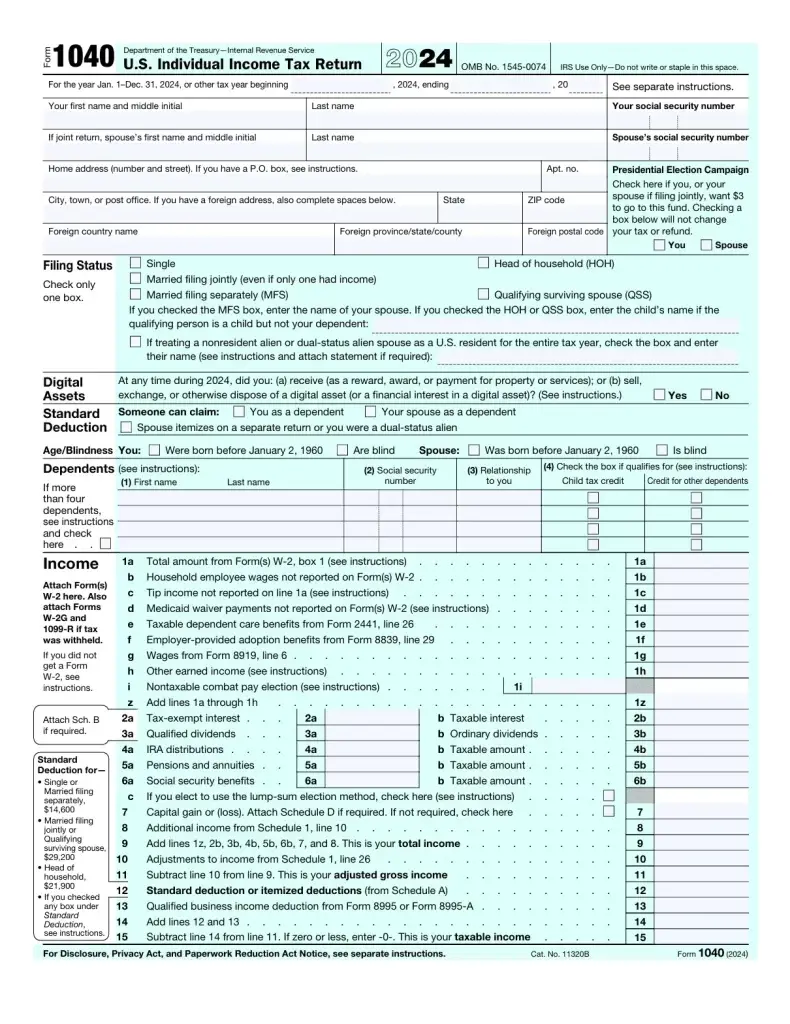
Here’s a detailed step-by-step overview on how you can file the federal tax form 1040 with page numbers and Lanes: 

Note: For queries or consultations, speak with a +1(866)500-0076 tax expert.

1040 tax form

1. Enter your personal information

Provide the following personal details on Page 1:   

  • Name 
  • Social Security Number (SSN)
  • Address 
  • Filing status (Single, Married Filing Jointly, or Head of Household
  • Enter the spouse’s name and SSN if you are filing jointly 

If you have dependents, provide their names, SSNs, and your relationship with them. You will also see the checkboxes to determine whether each dependent qualifies for the Child Tax Credit or the Credit for Other Dependents.

2. Specify your income 

On Line 1 Page 1, report your wages, salaries, and tips. Get all of your pay details on your W-2 form from your employer. If you file a paper return, attach Copy B of Form W-2. If you e-file, enter the W-2 information electronically.

Here are other taxable income sources after Line 1 when filing your taxes:  

  • Line 2a-2b: Tax-exempt and taxable interest.
  • Line 3a-3b: Qualified and ordinary dividends.
  • Line 4a-4b: IRA distributions.
  • Line 5a-5b: Pensions and annuities.
  • Line 6a-6b: Social Security benefits.
  • Line 7: Capital gains or losses (from Schedule D if applicable).
  • Line 8: Other income, such as unemployment benefits or gambling winnings, as reported on Schedule 1. 

3. Calculate the Adjusted Gross Income (AGI)

On Line 9, report your total income, which adds together all figures from the prior section. At this point, subtract any qualifying above-the-line adjustments from Schedule 1, including:

  • Educator costs
  • Health savings account (HSA) adjustments
  • Deduction for self-employment tax
  • Traditional IRA deposits
  • Student loan interest write-off

Removing these adjustments results in your adjusted gross income (AGI) shown on Line 11.

4. Determine the Deductions and Taxable Income

On Line 12, list either the standard deduction or itemized deductions from Schedule A. The standard deduction amounts for 2026 are:

  • $16,100 for individuals filing single
  • $32,200 for married taxpayers filing jointly
  • $24,150 for heads of household

If you qualify for the Qualified Business Income Deduction (QBI), record the amount on Line 13. Your taxable income appears on Line 15 from AGI.

5. Compute your Tax and Credits

Here’s how to figure out how much tax you owe to the IRS:

  • Find your tax amount: Start by entering the tax you owe based on your taxable income (Line 15) on Line 16. You can use the IRS Tax Tables in the Form 1040 instructions to find the correct tax amount based on your income and filing status.
  • Use tax credits: If you qualify for the Child Tax Credit or the Credit for Other Dependents, enter those amounts on Line 19. For any nonrefundable tax credits, enter them in the correct sections. Other credits, such as the Education Credit, Foreign Tax Credit, or Retirement Savings Contributions Credit, are listed on Schedule 3 and then transferred to Line 20 of Form 1040.
  • Add extra taxes: If they apply to you, include other taxes like self-employment tax, net investment income tax (NIIT), or alternative minimum tax (AMT). These are shown on Schedule 2, and the total is entered on Line 23.
  • Figure your total tax: Add your tax from Line 16 to any extra taxes from Line 23. Write this total tax amount on Line 24.
  • List payments and withholdings: If taxes were taken out of your pay, pension, or other income, enter those amounts on Line 25 and total them on Line 25d. If you made estimated tax payments, list them on Line 26.
  • Find your refund or balance due: If your total payments (Line 33) exceed your total tax (Line 24), you will receive a refund. Enter it on Line 34. If you still owe tax, subtract your payments from your total tax and enter the amount owed on Line 37. You can pay online using IRS Direct Pay or send a check with Form 1040-V.

Types of Federal Tax Form 1040 

Form 1040 is the main U.S. individual income tax return, and over time, it has had several types/variants. Here are the current and commonly referenced types:

Current Forms (as used today)

1. Form 1040 – U.S. Individual Income Tax Return

  • The standard form most taxpayers use.
  • Covers income, deductions, credits, and taxes owed/refunds.
  • Used by U.S. citizens and residents.

2. Form 1040-SR – U.S. Tax Return for Seniors

  • Designed for taxpayers age 65 or older.
  • Same tax calculations as Form 1040.
  • Larger print and a standard deduction chart are included.

3. Form 1040-NR – U.S. Nonresident Alien Income Tax Return

  • For nonresident aliens with U.S. income.
  • Used if you do not meet the substantial presence test or green card test.

4. Special Variants

  • Used to correct or amend a previously filed 1040, 1040-SR, or 1040-NR.

Form 1040 Schedules Explained 

Schedules Forms for 1040 have Supplementary and Itemized & Investment Schedules forms used to report income, deductions, and credits that do not fit on the main Form 1040 when filing annual income tax returns. 

Schedule 1 

Use Form 1040 to report your primary income. Additional income, such as unemployment benefits, prize or award money, or gambling winnings, must be reported on Schedule 1. This also applies if you have any deductions to claim, such as student loan interest, self-employment tax, or educator expenses.

Schedule 2

File your taxes with Schedule 2 1044 if you owe other taxes, such as self-employment tax, household employment taxes, additional tax on IRAs or other qualified retirement plans, and tax-favored accounts, AMT, or when you are required to pay an excess premium tax credit repayment. 

Schedule 3 

Use this form to claim tax credits you didn’t claim on Form 1040 or 1040-SR, such as the foreign tax credit, education credits, or general business credits. Or if you have other payments, such as amounts paid with a request for an extension to file or excess Social Security tax withheld.

There are other Itemized & Investment Schedules for supplementary forms used to report specific types of income. They are used with Form 1040 to report specific details of income and deductions. To learn more about each form, check the official IRS blog

Check the Deadline & Penalties 

Find out all the details about how long you can safely file Form 1040 without penalty and what you might have to pay if you file late:  

Note: For a detailed overview of deadlines and penalties, check the official guidelines on the IRS. 

Filing Deadline (Form 1040)

  • Form 1040 or 1040-SR is due April 15, 2026 
  • If you file after the due date, interest and penalties may apply 
  • Combat zone or contingency operation service members may qualify for a later filing deadline 
  • If you e-file, you do not need to mail the return 

Interest Charges

  • Interest is charged on:
    • Any tax not paid by the due date
    • Penalties that are not paid on time
  • Interest continues to accrue until the balance is fully paid

Penalties for Late or Incorrect Filing

1. Failure to File Penalty

  • Applies if you don’t file your return by the due date (including extensions)
  • Penalty may apply even if no tax is owed, depending on circumstances

2. Failure to Pay Penalty

  • Applies if you file but don’t pay the full amount owed by the due date
  • Penalty is in addition to interest

3. Underpayment of Estimated Tax

  • If you didn’t pay enough tax during the year, through:
    • Withholding, or
    • Estimated tax payments
  • You may owe a penalty, calculated using Form 2210

IRS option:

  • You may leave the penalty line blank, and the IRS will calculate the penalty and bill you
  • No interest is charged on the penalty if you pay by the date on the IRS bill

Criminal & Civil Penalties (General)

According to the IRS disclosure notice:

  • If you:
    • Fail to file,
    • Fail to provide the required information, or
    • Providing fraudulent information, you may be charged penalties and subject to criminal prosecution
  • The IRS may disallow:
    • Credits
    • Deductions
    • Exclusions that can increase tax or delay refunds

Refund Impact

  • Late filing or penalties can:
    • Delay refunds
    • Reduce refunds due to offsets for debts (tax, child support, student loans, etc.)

Conclusion 

Finally, we’ve reached the end of this blog, covering everything you need to know about federal tax Form 1040: what it is, the required information and documents, and more. You will learn how to file the form, along with a list of different forms that vary depending on the income type.

Filing taxes can be challenging, or waiting for your income tax return. Let our experts make it convenient for you by handling everything. Dial +1(866)500-0076 to connect with a QuickBookSupportNet professional. 

Frequently Asked Questions

What is IRS Form 1040 used for?

Form 1040 is used by individuals to file their annual federal income tax return. It reports income, adjustments, deductions, tax credits, taxes owed, and any refund due to the taxpayer.

Who must file Form 1040?

Most U.S. citizens and permanent residents must file Form 1040 if their income exceeds the IRS filing threshold, if they earned more than $400 from self-employment, or if they have special tax situations such as receiving unemployment benefits or claiming refundable credits.

What documents do I need to file Form 1040?

Common documents include W-2s, 1099 forms (1099-NEC, 1099-INT, 1099-DIV, etc.), Social Security numbers for you and your dependents, records of deductions and credits, prior-year tax returns, and bank information for direct deposit or payments.

What is the difference between Form 1040 and Form 1040-SR?

Form 1040-SR is designed for taxpayers aged 65 or older. It has the same tax calculations as Form 1040 but features larger print and includes a standard deduction chart for seniors.

Can I file Form 1040 even if I’m not required to?

Yes. Filing Form 1040 even when not required can be beneficial because you may be eligible for a tax refund, refundable credits, or recovery of taxes that were withheld from your paycheck.

What happens if I file Form 1040 late?

Filing late may result in penalties and interest, especially if you owe taxes. Late filing can also delay refunds. If you cannot file by the deadline, you may request an extension, but taxes owed must still be paid by the original due date.

How can I file Form 1040?

You can file Form 1040 electronically using IRS-approved e-file providers, tax software, or through a tax professional. You may also file a paper return by mail, although electronic filing is faster and reduces errors

About The Author

Lana Creston

Lana Creston is an experienced technical and accounting writer with a total of 9 years of experience. She currently works on QuickBooks accounting and technical guides at QuickBookSupportNet. Lana has a passion for reading and writing about various technical topics, especially exploring new accounting methods and software, while continuously expanding her expertise in the ever-evolving field of finance and technology.

Quick, clear, and hassle-free QuickBooks assistance.

Get a Free Consultation with Our QB Tax Experts
Connnect with Our Certified QuickBooks Professionals - Dial Tollfree: +1(866)500-0076