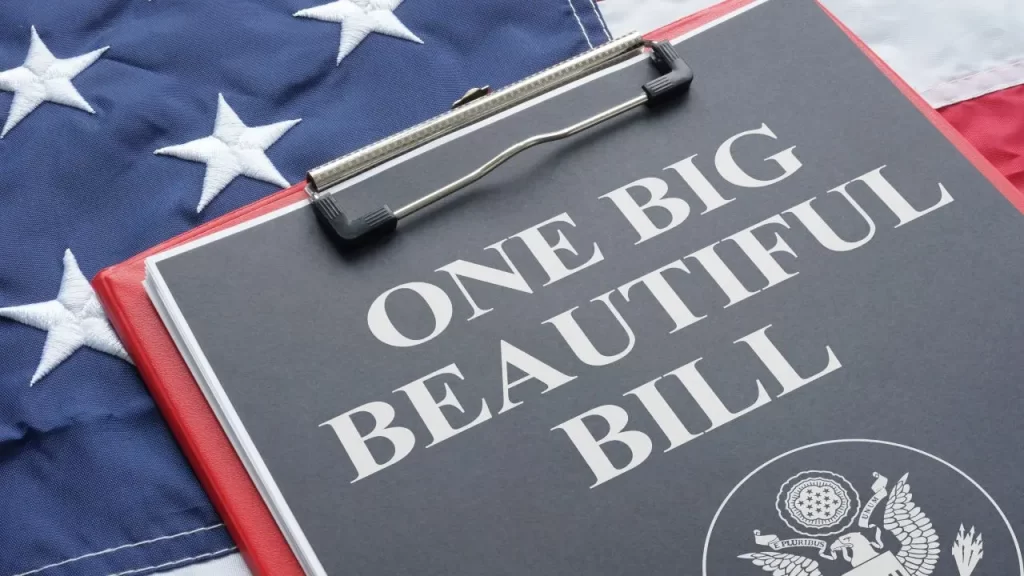

One Big Beautiful Bill: 2025 Guide to File Your Tax Return

Jan 22, 2026

Admin |

Estimated Read Time : 5 MIN

For any business, filing a tax return is as necessary as breathing to live. With the passage of the One Big, Beautiful Bill, the whole tax system of the U.S. has somewhat changed. With the latest update on the U.S. tax system, we bring you this blog loaded with information in simpler terms.

white house

Walk through this guide, get your confusion into clarity, and file your tax within the time period with no penalty. We will also cover certain programs that were repealed, such as the National Education and Obesity Prevention Grant Program. Keep reading and stay informed with this blog on the One Big Beautiful Bill Act of 2025.

What is the One Big Beautiful Bill Act?

The One Big Beautiful Bill Act is a U.S. federal statute that contains tax and spending policies with hundreds of provisions. The provision in OBBBA includes categories from child to student, vehicle, and clean energy to Charitable contribution tax deduction. For some living groups of people, it includes deductions for overtime pay, auto loans, and tips, and allows parents to create tax-deferred accounts for their children’s benefits.

One Big Beautiful Bill Act

OBBBA allows a tax deduction for cash donations to charity for individuals or married filing jointly. For an individual, the tax deduction is limited to $1,000, and for married filing together, it is $2,000.

One Big Beautiful Bill Provisions

The One, Big, Beautiful Bill Act affects your federal taxes, credits, and deductions. The bill turned into law on 4th July, 2025, as Public Law 119-21. 

Below is the summary of the major provisions included in the One Big Beautiful Bill Act.

1. Federal Tax Code Changes

Individual tax provisions

  • Inflation-adjusted tax brackets and deductions: Adjusts standard deduction and marginal tax rate thresholds, preserving larger standard deductions and lower rates for many filers.
  • Employer-provided childcare: Expanded credit for employer childcare expenses. 

Business and other tax provisions

  • Agricultural and rural lending benefit: New rule allowing certain lenders to exclude a portion of interest income on qualifying rural loans.
  • Business tax incentives: Increase in business deductions, for example, equipment and research costs, and cuts to some business taxes. 
  • Information reporting rules: Enhanced IRS reporting/withholding requirements on certain payment types. 

2. Health Care Program Reforms

Medicaid

  • Work requirements: Able-bodied adults must work or participate in approved activities such as volunteering, school for ~80 hours/month to retain eligibility. 
  • Provider tax cut: Gradual reduction of the Medicaid provider tax rate through 2031. 
  • Service charges: Some Medicaid expansion enrollees may be charged up to $35 per service in certain circumstances.
  • Rural Hospital Fund expansion: To support rural health providers, there is increased funding.

Other health provisions

  • Changes to Medicare payment rates, including a reimbursement rate increase for 2026 and expansion of home and community-based care for people with disabilities.
  • Telehealth improvements: Telehealth copays may be covered outside of overall deductibles in some cases. 

3. SNAP and Nutrition

  • Work requirements tightened for Supplemental Nutrition Assistance Program recipients. 
  • Eligibility and administrative reforms for SNAP, including utility allowances, quality control, and matching requirements. 
  • Implements technical changes to how SNAP benefits are managed and monitored.

4. Miscellaneous Domestic Policy Items

  • The new tax credit for metallurgical coal is approximately 2.5%. 
  • Air traffic control funding boost to around ~$12 billion. 
  • NASA funding increases by around ~$10 billion, including space exploration and operations. 
  • Remittance tax is 1% on foreign cash transfers with revenue provisions.

5. Context & Impact

  • The law makes many TCJA tax changes permanent while adding both new permanent and temporary provisions. 
  • Health care reforms and SNAP changes are among the most consequential non-tax aspects.
  • Combined, health and nutrition provisions are projected to significantly reduce federal spending and affect insurance coverage rates through the Financial Year 2034.

What is No Tax on Overtime?

In simple terms, no tax on Overtime means that you, as a worker, can deduct up to $12,500 from your taxable income under qualified overtime compensation on your federal income tax return. For joint fillers, the deductible amount is up to $25,000.

2025 Tax Bracket 

Tax rateSingle filersMarried filing jointlyHead of household
10%$0 to $11,925$0 to $23,850$0 to $17,000
12%$11,926 to $48,475$23,851 to $96,950$17,001 to $64,850
22%$48,476 to $103,350$96,951 to $206,700$64,851 to $103,350
24%$103,351 to $197,300$206,701 to $394,600$103,351 to $197,300
32%$197,301 to $250,525$394,601 to $501,050$197,301 to $250,500
35%$250,526 to $626,350$501,051 to $751,600$250,501 to $626,350
37%over $626,350over $751,600over $626,350

2026 tax brackets

Tax rateSingle filersMarried filing jointlyHead of household
10%$0 to $12,400$0 to $24,800$0 to $17,700
12%$12,401 to $50,400$24,801 to $100,800$17,701 to $67,450
22%$50,401 to $105,700$100,801 to $211,400$67,451 to $105,700
24%$105,701 to $201,775$211,401 to $403,550$105,701 to $201,750
32%$201,776 to $256,225$403,551 to $512,450$201,751 to $256,200
35%$256,226 to $640,600$512,451 to $768,700$256,201 to $640,600
37%Over $640,600Over $768,700Over $640,600
  • You can report overtime on Form W-2, Form 1099, and the maximum yearly deduction is limited to $12.5K.
  • Overtime is phased out for taxpayers with over $150K as a modified adjusted gross income. For joint fillers, it is $30,000. 

Who can opt for No Tax on Overtime?

If you work (under a certain category) more than the official working hours, it means you qualify for No Tax on Overtime. 

  • Non-exempt employees

As a non-exempt worker, you are eligible for overtime pay and receive a 1099 or W-2 form. For the information, non-exempt workers are mostly hourly workers; however, the Department of Labor also counts some salaried employees with income under $648/week. 

  • Deduction for seniors 

The question that arises at first is, who comes under the Senior category? When any individual turns 65 years of age during the tax year, it comes under the Senior category. Since the One Big Beautiful Bill became an act, seniors can now apply for the Senior Deduction for tax years 2025 and enjoy the advantage of reducing their taxable income by $6,000 each. The condition is that one must meet the requirements. 

If you or any of your family members age 65 or older can claim an additional $6k deduction.

This is standard deduction + additional for seniors that are available under existing law.

OBBBA is not applied to taxpayers with modified adjusted gross income of +$75k or +$150k for joint filers.

Eligibility

  • The taxpayer must be 65 on or prior to the last day of the tax year.
  • It includes both itemizing and non-itemizing eligible taxpayers.

Tip: you are looking for any help to prepare your tax return, you may qualify for the IRS’s Volunteer Income Tax Assistance and Tax Counselling for the Elderly programs. Contact us at +1(866)500-0076. QuickBookSupportNet can handle the necessary calculations for you and tell you how much you may receive under the Tax Credit for the Elderly or Disabled.   

How can you claim the deduction?

  • You need to include your Social Security Number on the return.
  • If you are married, file jointly.

No Tax on Tips

Effective 2025 through 2028, self-employed individuals and employees may deduct qualified tips they received in occupations that are considered to customarily and regularly receive tips. When the bill talks about Qualified tips, it includes charged tips received from customers or voluntary cash. The maximum yearly deduction is limited to $25,000. 

Who is qualified for No Tax on tips?

  • Have a SSN.
  • Who can claim itemized or non-itemized deductions? 

Trump Accounts

A trump account is an individual retirement account for the exclusive benefit of an eligible person. IRA is designated at its establishment as a Trump account. When the Trump account becomes active, it will be eligible. The individual is the owner of the Trump account. 

Trump Accounts

Popular trump account, in other words, called Working Families Tax Cuts, allows parents, guardians, and authorized individuals to open a new type of individual retirement account for their children. The account is for the child who is still under the age of 18 years before the end of the calendar year and has a valid SSN.

Charitable Contribution Tax Deduction

  • For non-itemizers, there is an increase in the standard deduction under the One Big Beautiful Bill Act, and also an above-the-line deduction for your charitable donations. 
  • There are some kinds of limitations that are not applicable until 2026. It results in taxpayers bunching their charitable donations and can take advantage of the delay in 2025.
  • The OBBBA 2025 for itemizers creates a floor on the charitable deduction and a limitation on the value under the itemized categorization for taxpayers in the top bracket. 

Tax-exempt organizations

With OBBBA 2025, certain organizations with tax exemptions are required to pay an excise tax on compensation exceeding $1 million paid to any former or current employee. 

Conclusion

In this guide, One Big Beautiful Bill is explained with the latest details. Now, you can easily file your tax return knowing your taxable income, credits and more. We included One Big Beautiful Bill provisions, no tax on Overtime, No Tax on tips and more. We shed light on Trump’s account and charitable contribution tax deduction. Hopefully, you have understood enough about the OBBBA.

If you are looking for experts to file your tax return, contact QuickBookSupportNet Team at +1(866)500-0076 and let us do the rest! 

Frequently Asked Question 

1. What is Qualified Business Income?

Qualified Business Income is the net amount of income, gain, deduction, and loss from the approved items in any qualified trade or business. Items that are included in the taxable income are counted in the qualified business income, whereas excluded items include capital gains and losses, interest income, and certain dividends. 

2. What is H.R. 1?

H.R. 1 is the Reconciliation Bill that turned into law, making significant changes to Medicaid and the Health Insurance Marketplaces. 

3. Where should I contact to file my tax return?

If you are looking for a tax expert to file your tax return, contact QuickBookSupportNet at +1(866)500-0076. 

4. What is One, Big, Beautiful Bill 2025? 

The One Big Beautiful Bill Act is a U.S. federal statute that contains tax and spending policies with hundreds of provisions. The provision in OBBBA includes categories from child to student, vehicle, and clean energy to Charitable contribution tax deduction.

5. How is the OBBBA affecting billionaires? 

The OBBBA makes the Tax Cuts and Jobs Act’s top individual income tax rates up to 37% permanent, providing long-term certainty for the highest earners. 

About The Author

Lana Creston

Lana Creston is an experienced technical and accounting writer with a total of 9 years of experience. She currently works on QuickBooks accounting and technical guides at QuickBookSupportNet. Lana has a passion for reading and writing about various technical topics, especially exploring new accounting methods and software, while continuously expanding her expertise in the ever-evolving field of finance and technology.

Quick, clear, and hassle-free QuickBooks assistance.

Get a Free Consultation with Our QB Tax Experts
Connnect with Our Certified QuickBooks Professionals - Dial Tollfree: +1(866)500-0076