
QuickBooks Portable Company File: Setup & Sharing Guide

Apr 13, 2026

Admin |

Estimated Read Time : 5 MIN

Managing and sharing financial data efficiently is a key part of using QuickBooks Desktop, especially for businesses that collaborate with accountants or work across multiple systems. This is where the QuickBooks Portable Company File becomes incredibly useful. 

Whether you need to send your books to an accountant, move your data to another computer, or create a streamlined backup, a Portable Company File offers a practical solution without the bulk of a full company file. It helps reduce file size, speeds up transfers, and ensures that your core financial data remains intact during the process.

In this guide, we’ll walk you through how to set up and share a QuickBooks Portable Company File step by step, along with best practices to ensure your data stays secure and error-free.

What is a Portable Company File in QuickBooks Desktop? 

A Portable Company File in QuickBooks Desktop is a compact, compressed version of your company data file designed for easy transfer and backup. It uses the `.QBM` file format and contains all your essential financial data—such as transactions, lists, and templates—while excluding certain elements like the transaction log file (`.TLG`) and some cached data. This makes it significantly smaller in size compared to a standard company file (`.QBW`).

When you restore a Portable Company File, QuickBooks automatically rebuilds the company file and reindexes the data, which can help fix minor data issues and improve file performance. However, it’s important to note that a portable file is not a full backup replacement—it doesn’t include everything. For complete data protection, you should still maintain regular full backups.

Let’s Create a QuickBooks Portable Company File for Easy Transfer 

Before creating a portable file, ensure your software and data are ready for a smooth process. 

Step 1: Update QuickBooks

    Before creating or working with a Portable Company File, make sure your QuickBooks Desktop is up to date. Using an outdated version can lead to compatibility issues, errors during creation or restoration of the portable file, or even data corruption.

    Step 2: Consider creating a backup

      Portable company files are a convenient option for sharing or transferring your accounting data without creating a full backup. They reduce file size and make it easier to move data between systems or send it online.

      However, a portable company file should not be considered a substitute for a complete backup. It does not include certain important elements such as message templates, logos, images, and customized templates.

      For full data protection, it’s essential to create complete backups of your company file regularly. 

      And if your goal is to collaborate with an accountant, it’s often better to send an Accountant’s Copy, which is specifically designed for that purpose.

      Step 3: Create a portable company file

        To create a portable version of your company file:

        • Open QuickBooks and sign in as the administrator.
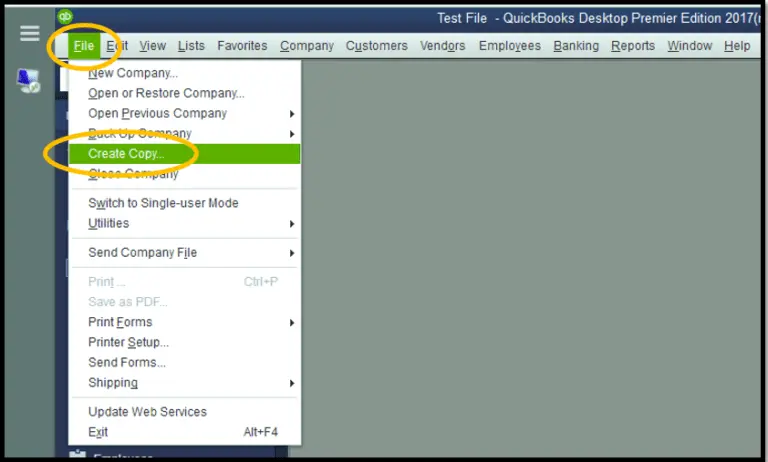
        • Go to the File menu and choose Create Copy.
        Create Portable Company File
        • Select the Portable company file, then click Next.
        • Enter a distinct name for your portable file so it’s easy to differentiate from the original company file.
        • Choose a location to save it, preferably somewhere convenient like your desktop.
        • Once everything is set, click Save and then OK.

        Your portable company file is now ready to be shared online or transferred via a USB drive. It will appear in this format:[Unique company file name].qbm.

        Note: When you share a portable file, the recipient will have full access to the data it contains. The file is protected, and they will need the correct password to open it.

        Step 4: Open a portable company file

          To access a portable version of your company file:

          • Launch QuickBooks and sign in as the admin user.
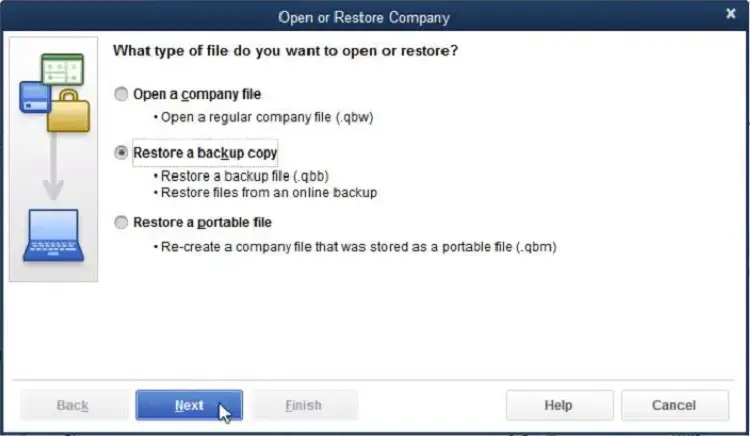
          • Navigate to the File menu and click on Open or Restore Company.
          Open or Restore Company
          • Choose Restore a portable file and then click Next.
          • Locate your portable file, which will appear as [Unique company file name].qbm, and select Open.

          Important: Avoid using identical names for both the portable and regular company files. If they are stored in the same location, the portable file may replace the original.

          • You can either rename the portable file or choose a different folder to save it.
          • Review the information on the Where do you want to restore the file screen, then click Next.
          • Once everything is set, click Save to open the file.

          When the portable company file is opened, QuickBooks automatically rebuilds and reindexes the data, which helps resolve many common data problems.

          Conclusion 

          Creating a portable company file in QuickBooks helps you streamline data sharing, back up essential information, and simplify file transfers without compromising accuracy. With this detailed guide, you must have learned how you can create and use a QuickBooks portable company file efficiently. If you encounter any errors or issues during the process, we recommend consulting QuickBooks ProAdvisors.

          The team of QuickBooks professionals is available 24/7 to assist you with the best solutions. Dial (866) 500-0076 now!

          Frequently Asked Questions 

          What is a portable company file in QuickBooks Desktop?

            A portable company file in QuickBooks Desktop (extension .QBM) is a highly compressed, compact version of your main company file (.QBW) used to easily share data via email or portable drives.

            How to create a portable company file?

              To create a portable company file in QuickBooks Desktop, go to File > Create Copy, select Portable company file, and click Next. Choose a save location (like your desktop), name the file, and click Save. QuickBooks will close and reopen to create the compact, email-friendly .qbm file. 

              How do I add another company file to QuickBooks Desktop?

                To add another company file in QuickBooks Desktop, go to the File menu, select Open or Restore Company, choose Open a company file, and navigate to the location of the new file. You can run multiple companies simultaneously, with the second file often functioning as a “secondary” company with restricted features.

                Where can I find QuickBooks company files?

                  QuickBooks Desktop company files (.qbw) are usually stored in the public documents folder: C:\Users\Public\Public Documents\Intuit\QuickBooks\Company Files. You can also find them by searching for *.qbw in Windows File Explorer or using the “Find a company file” option on the QuickBooks startup screen. 

                  About The Author

                  Lana Creston

                  Lana Creston is an experienced technical and accounting writer with a total of 9 years of experience. She currently works on QuickBooks accounting and technical guides at QuickBookSupportNet. Lana has a passion for reading and writing about various technical topics, especially exploring new accounting methods and software, while continuously expanding her expertise in the ever-evolving field of finance and technology.

                  Quick, clear, and hassle-free QuickBooks assistance.

                  Get a Free Consultation with Our QB Tax Experts
                  Connect with Our Certified QuickBooks Professionals - Dial Tollfree: +1(866)500-0076